
Our Blog

Fall’s in the Air? Think Fall Dental Care

October 16th, 2025

Whether you already miss the sun’s bright rays, or can’t wait for some cool, crisp weather and colorful leaves, summer is making way for fall. And the change of seasons might mean it’s time for some adjustments to your dental care routine.

Fall’s in the Air, and You Can Feel It

You might enjoy the brisk weather and the cool autumn breezes, but you’d enjoy fall much more without the tooth sensitivity that cold weather can bring. Sensitivity can be the sign of a cracked tooth, gum disease, or even something as simple as too-energetic brushing. If you’re experiencing sensitivity outdoors or with hot and cold foods, don’t give up your nature walks and hot cider! Give Dr. Tavory a call, and we’ll get to the root of your problem.

Fall Sports

The baseball mitts, surfboards, and water skis have been retired for the year, but that won’t stop you from enjoying exercise and team sports. And while you’re keeping your body healthy, remember to keep your teeth and jaws healthy as well. A mouth guard is an essential piece of equipment for any autumn contact sport like football or soccer, and is also a good idea for biking, skateboarding, and other physical activities where a fall or a collision is a possibility.

Fall Feasts

‘Tis the season for sugary Halloween treats, bountiful Thanksgiving desserts, and those over-the-top holiday lattes. By all means, celebrate the season. And celebrate your dental health (and your overall health) as well by enjoying these treats in moderation.

Why not take this opportunity to explore some of autumn’s more nutritious seasonal offerings? Brussels sprouts, sweet potatoes, carrots, pumpkins, and apples are part of a fall harvest of fruits and vegetables rich in vitamin A, vitamin C, potassium, calcium, and other nutrients that help keep our teeth and gums their healthiest. (And if the pumpkins and apples make their way into pies, no one will complain.)

Fall Semester

Many schools require a dental exam before the start of the academic year. If you haven’t made an appointment for your child, now’s the time to do it! And don’t forget a professional cleaning to remove plaque and tartar. Nothing starts a school year off better than entering the classroom with a bright, healthy smile.

And don’t forget to call our Boca Raton office for your own regular checkup if it’s that time of year. Spring, summer, winter, fall—it’s always the right season for taking care of your dental health!
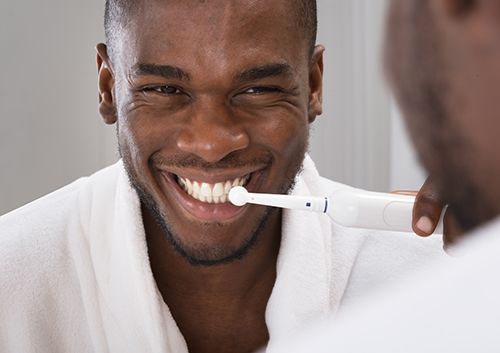
Electric Toothbrushes vs. Regular Toothbrushes

September 24th, 2025

Convertible or sedan? Downtown or suburbs? Electric or manual toothbrush? As life decisions go, it’s certainly not choosing your next car, or deciding where you want to live. But, even when you are selecting a toothbrush, it helps to make a list of the pros and cons of the contenders before you make that final selection.

  • Efficiency

The most important factor in choosing a toothbrush is finding out which model works best to eliminate bacteria and plaque. And studies have shown that, used properly, both electric and manual toothbrushes do a great job of removing plaque. Some electric models can reach the backs of teeth and the gumline more easily, some manual head designs work better for your individual mouth and teeth, so your particular needs should dictate which style of toothbrush you use. Talk to us about the best methods to brush with your preferred toothbrush, and we’ll let you know if one type of toothbrush or the other might work better for you.

  • Health Considerations

Brushing too energetically can actually harm teeth and gums, causing sensitivity and damage to the enamel and gum tissue. An electric toothbrush should provide a continuous brushing motion without needing any pressure from the brusher. This might be the model for you if you have a too-vigorous approach to brushing, or sensitive teeth and gums.

An electric toothbrush can also be more efficient for older and younger brushers, those with limited mobility, and those with health conditions or injuries that make brushing with a regular toothbrush more difficult.

  • Cost

An electric toothbrush is not a one-time investment. You should change the removable head as often as you change your manual toothbrush (every three to four months, please). But this cost is offset if an electric toothbrush is more efficient in removing your plaque, easier to use, or even if you just prefer it to manual brushing. If you find that you brush better and more often with an electric toothbrush, the added expense is well worth it.

Whichever brush you decide on, the most important part of the brush is the person holding it! A regular appointment with your toothbrush for two minutes of thorough brushing in the morning and two in the evening, daily flossing, and regular visits to our office for checkups and cleanings will keep your teeth healthy and strong no matter which toothbrush you choose.

Questions about your toothbrush choices? Don’t hesitate to ask John Burke at our Frankfort, IL office.

Your Options for Sedation Dentistry

September 24th, 2025

Fear of going to the dentist is more common than you may think. That’s why Dr. Tavory and our team want to make your visit as relaxing as possible.

Your anxiety about pain or routine procedures doesn’t have to stop you from visiting our Boca Raton office; we offer various types of sedation to remove the pain and stress from your dental procedure.

Nitrous Oxide Sedation

Nitrous oxide combined with local anesthetics ensures both pain relief and reduced anxiety for many patients. It’s useful because the dosage can be regulated during treatment, and patients are usually able to drive shortly after the procedure is completed.

Oral or Injected Sedation

With oral sedation, you may be given a pill or liquid to consume several hours before your treatment. Make sure someone will be available to drive you to your appointment, because you will not be able to drive yourself.

An oral liquid is often given to children before any shots or intravenous anesthesia. An intramuscular injection may be given at the office to provide relaxation benefits for 20 to 30 minutes.

Nitrous Oxide with an Oral Sedative

For patients with higher levels of anxiety, an oral or injected sedative can be offered before nitrous oxide begins. This can also be effective for reducing anxiety about the injection of local anesthetics itself. A liquid medication followed by nitrous oxide is beneficial for children to produce a deep sedation level.

General Anesthesia

This type of anesthesia can be offered as an inhaled gas or intravenous liquid. If no oral sedative is given before the general anesthesia is administered, you should wake up quickly after your procedure.

To reduce your anxiety, we can offer a pill or liquid medication before intravenous sedation starts. Intravenous sedation can also be used at moderate-to-deep sedation levels without complete loss of consciousness.

Dr. Tavory and our team are happy to go over your sedation or pain prevention options when you visit. We’re here to ensure all your questions are answered and your procedure is a relaxing one.

Power Chains

September 17th, 2025

By now, you’re very familiar with the basic building blocks of your braces. Brackets, wires, and ligatures are no mystery to you. But suddenly, you’re hearing a brand new term—“power chains.” What exactly are these power chains, and why does your orthodontist think you need them? Let’s see how power chains are *linked* to your orthodontic treatment.

  • First, why power chains?

They’re not really chains in the necklace or bike chain sense—in fact, they’re only very rarely made with metal. These chains are most often a string of O ring loops just like your elastic ligatures, attached in a row to resemble a chain.

Chain lengths are tailored to your specific needs. John Burke will attach each individual loop in the chain around a single bracket, linking selected teeth together. Chains might stretch across a few teeth, several teeth, or your entire upper or lower arch.

  • Second, why power chains?

Because these chains are usually made of the same elastics that your ligatures, or bands, are made from, they want to hold their original shape. They will try to return to that original shape even as they are stretched between your brackets. As they contract, they help move your teeth together. 

Over time, just like an over-stretched rubber band, they lose their elasticity, and won’t work as effectively. That’s why you’ll probably get a new power chain whenever you come in to our Frankfort, IL office for an adjustment.

  • Third, why power chains?

This is the most important question. How can a power chain improve your smile?

Usually, power chains become part of your treatment after the first phase of alignment. They can be used to help align your teeth or correct your bite, but are most often used to close gaps between the teeth.

You might have a gap after a tooth has been extracted. Or, as your teeth move into their new positions, you might suddenly see noticeable spaces between them. Power chains move the teeth closer together to eliminate these gaps, and do it more quickly than brackets and wires alone can do.

  • How long will you need them?

This is something John Burke will discuss with you. Whether it’s a matter of weeks or months, your treatment plan is designed to move your teeth into their best positions, and to do it carefully for a lasting, healthy alignment.

  • Power chain options

Depending on the size and spacing of your teeth and your treatment plan, these chains usually take one of three forms: closed/continuous, short, and long. The only difference is the distance between the rings.

We will choose the type of chain that’s best for your treatment. Your contribution is to personalize your power chain. Power chains come in a rainbow of colors, allowing you to mix and match. You can even coordinate with your ligatures if you have ties as well as chains. If your goal is to have your braces blend in, various shades of white, silver, or clear colors are available. Want to mix things up? Choose a different color with every adjustment.

  • Anything else?

You might experience some discomfort for the first few days with a new power chain, just as you might with any adjustment. John Burke will have suggestions for making those first days as comfortable as possible.

Also, like brackets and ligatures, power chains can trap food particles, so be sure to follow our instructions for keeping your teeth and your braces their cleanest.

Now that you’re all caught up on what power chains are and what they can do for you, let’s mention one more benefit. This is a process where you can actually see the gaps between your teeth closing over the weeks you wear your power chains. Keep a selfie record of your progress as you create your beautiful, healthy smile. That’s an em*power*ing experience!

Contact Us!
call email