Our Blog

Tips to Keep Braces Clean

December 16th, 2020
Orthodontic technology changes and improves all the time. Today’s braces are lighter, smaller, and more efficient than those of past years. Wires are thinner and more flexible. Even brackets come in different styles and colors. These developments are all great news for braces wearers. Unfortunately, there is one advancement we haven’t been able to offer: self-cleaning braces.

Brackets and wires can both trap food particles and make brushing them away more difficult. This can lead to increased plaque, cavities, and staining around the area of your braces. But with the proper supplies and habits, keeping your braces clean will become routine in no time.

Braces-healthy Supplies

  • Toothbrush

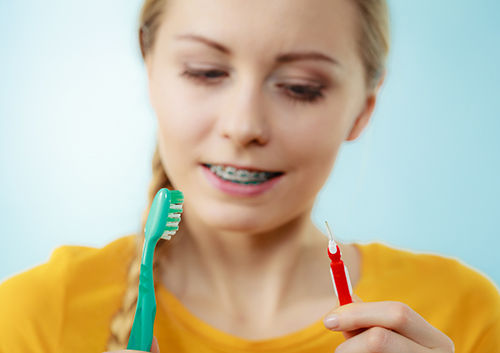
Your old toothbrush might work well enough with some brushing adjustments. We can show you how to angle your brush so it works most effectively, and how to make sure the bristles clean around your braces. Or, if you like, there are actually manual toothbrushes designed just for braces. These have V-shaped bristles to make cleaning around the brackets easier. Some people find an electric toothbrush works best. Whichever type of brush you use, be sure you use it often!

  • Floss

Again, if regular floss works for you, stay with your normal products. If you are finding it difficult to get into the narrow spaces around your braces, there are floss threaders to get the floss into tight spaces, and flosses specially designed to work with braces.

  • Interproximal brush

A big name for a tiny brush! These little cone-shaped brushes can clean around your brackets and under your wires—a great way to reach parts of your teeth your regular brush can’t.

Braces-healthy Habits

  • Brush after every meal and sugary drink

Because food particles tend to stick to your braces, and the bacteria in plaque feed on these particles, your enamel is under attack without thorough cleaning after meals. Take a toothbrush and supplies with you to school or work so that you can always brush after eating. If there is absolutely no way to brush, be sure to rinse immediately with water.

  • Brush carefully

Pay attention to each tooth, the area around your braces, and your gum line. And don’t forget the tops and inside of your teeth! A common suggestion for braces wearers is to devote at least ten seconds to each tooth. We might also recommend a special mouthwash to reduce bacteria and help keep your mouth and breath fresh.

  • Brush on the go

Put together a cleaning kit for when you are out of the house. A brush, some floss, and toothpaste in a handy container will let you brush whenever you need to, wherever you may be. Leave it in your backpack or bag, and you’re ready for anything!

  • Watch your diet

Foods that stick to teeth will stick to braces, so avoid caramels, licorice, chewy candies, and any other sticky treats. Why make your life more difficult?

While braces can make brushing and flossing more complicated, you can still keep your teeth clean, bright, and cavity-free. And remember, regular dental exams and professional cleanings are more important than ever during this time. At your next visit to our Frankfort, IL office, talk to John Burke about the best products and practices for the cleanest possible teeth and braces. We have plenty of ideas to help make sure you’ll have the healthy, beautiful smile you’ve worked so hard for when those braces come off!

Five Tips in Caring for Your Braces During Orthodontic Treatment

December 9th, 2020

After getting your braces, it is important to know how to take care of your teeth in order to ensure that your braces stay intact and do their job so that your teeth are in top-notch condition after you complete your orthodontic treatment. Today, our team at Burke Orthodontics thought we would provide you with five tips you need to know to ensure you undergo successful treatment at our Frankfort, IL office.

Flossing
Flossing twice a day or after every meal can help you clean areas between teeth and other places a toothbrush can miss. We also recommend using a floss threader, which can be used to help you navigate safely around your braces and brackets. It is vital to floss twice a day, preferably after lunch and before bedtime to keep gum disease and tooth decay at bay.

Brushing
Teeth and appliances should be brushed after every meal and before bedtime using fluoride toothpaste and gentle, soft strokes. We recommend using an interdental toothbrush, which can help you clean the hard-to-reach areas under wires better than an ordinary toothbrush.

Using Elastics
This phase of orthodontic treatment requires cooperation and consistency on your part. If your orthodontist has prescribed elastics, make sure they are worn at all times, except when eating meals or brushing teeth. It’s important that you wear the correct size elastics and have extras in case they are misplaced. By failing to wear your elastics for even one day, you run the risk your teeth moving back toward their original position.

Addressing Damage to Your Braces
In case your appliances are damaged, we ask that you call our team at Burke Orthodontics immediately to set up an appointment.

Eat Friendly Foods
When undergoing treatment, there are certain foods you must avoid. Foods that are hard, sticky, chewy or sour can add months to your treatment time. These includes gum, caramels, taco shells, nuts, ice, chips or hard candies.

We hope that helps! If you have any questions, please give us a call at our Frankfort, IL office or ask us during your next adjustment appointment!

Celebrate the Season with Braces-Friendly Treats

December 2nd, 2020

It’s the most wonderful time of the year, with the holidays around the corner, and visions of sugarplums and other tasty desserts dancing in everyone’s head.

Except, this year you have braces. This means some of your favorites might be on the naughty list. What to avoid? The same kinds of foods that you avoid now: anything hard, crunchy, sticky, or chewy. This means some of the traditional holiday favorites will have to be postponed for a while:

  • Pecan Pies

A festive tradition! But, nuts in a sticky sugar filling? Time to create a new dessert tradition that will be less of a problem for wires and brackets.

  • Gum Drops, Caramels, & Toffees

These super-sticky, chewy treats are definitely hazardous for your braces. Find a soft candy alternative instead.

  • Candy Canes & Hard Candies

Hard, sticky, and crunchy? Let’s save these candies for decorating the gingerbread house this year.

So what can you eat?

Luckily, there are plenty of dessert options that are nice to wires and brackets! Let’s look at some festive treats that also easy on your braces.

  • Cupcakes & Cakes

Soft, moist cupcakes and cakes should be no problem. Fruitcake, with its sticky dried fruits and nuts, should be avoided—which is a perfect excuse if you’re not a fan!

  • Pudding

Puddings are a smooth easy-to-eat treat, so enjoy! But know your puddings. Some traditional holiday puddings are more cakelike and contain the same chewy ingredients as fruitcakes, so the same advice applies—if it contains dried fruits and nuts, this is not the dessert for you.

  • Soft Candies

The same soft chocolates that you could eat for Halloween are good now, too! If it’s just not the holidays without peppermint, smooth peppermint patties are the way to go.

  • Pies & Other Favorites

Pecan pies are a firm no, but velvety desserts like pumpkin pie, cream pies, and cheesecake should be fine. And be sure you pick only the soft cookies in the holiday cookie exchange!

When you visit our Frankfort, IL office, ask John Burke about these and other holiday treats to make sure they are safe for you and your braces. And one more word before we all dig in—too much sugar in your diet creates the perfect conditions for cavity-causing bacteria. But there’s no need to give up all your holiday treats.

Just as you would brush after any dessert without braces, be sure to brush now that you have them. Be especially careful to remove any sugary residue from around your brackets, between your teeth, and near your gum line. And it’s always best to eat sweet treats as part of a meal, to reduce the effect of sugars and acids on your teeth.

Oh, and about those sugarplums? These candies originally contained no soft, tender plums at all. They were actually tiny treats created by coating a seed or nut center with a hard sugar shell. But you don’t need to worry about missing out on Victorian treats—with all of your delicious and braces-safe dessert choices, you’ll be enjoying a very sweet holiday season!

Thanksgiving

November 25th, 2020

At Burke Orthodontics, we love to celebrate the holidays with vigor! John Burke would love to share some unique ways of celebrating Thanksgiving from beyond the Frankfort, IL area to the national level!

When Americans sit down to dinner on the last Thursday of November, the day that Abraham Lincoln designated as the day on which Thanksgiving would be celebrated, they do so thinking that the first Thanksgiving feast was held at Plymouth in 1621. According to National Geographic, the Spanish explorer Francisco Vásquez Coronado and his men celebrated a feast of Thanksgiving in Texas in 1541, giving Texas the distinction of being the first place where Thanksgiving was celebrated.

Different Types of Celebrations

Native Americans had rituals around which they celebrated in hopes of ensuring a bountiful harvest. The Cherokees had a Green Corn Dance that they did for this very purpose. The Pilgrims (not to be confused with the Puritans,) rejected any type of public religious display. They held a three-day long non-religious Thanksgiving feast. Although they said grace, the focus of their celebration was on feasting, drinking alcohol (they did have beer,) and playing games.

The Pilgrims at the Plymouth Plantation celebrated a different day of Thanksgiving in 1623. Plagued by a crop-destroying drought, the settlers prayed for relief. They even fasted. A few days later, they got the rain they so desperately needed. Soon thereafter, they received another blessing when Captain Miles Standish came with staples they couldn't otherwise get. He also told them that a Dutch supply ship was en route. In gratitude for the abundance of good fortune, the Plymouth settlers celebrated a day of prayer and Thanksgiving on June 30, 1623.

The Story of Squanto

No discussion of Thanksgiving is complete without a discussion of Squanto, or Tisquantum, as he was known among his people, the Patuxet Indians. It is believed that he was born sometime around 1580. As he returned to his village after a long journey, he and several other Native Americans were kidnapped by Jamestown colonist, Thomas Hunt. Hunt put them on a ship heading to Spain where they were to be sold into slavery.

As fate would have it, some local friars rescued him and many of the other kidnapped natives. Squanto was educated by the friars. Eventually, after asking for freedom so he could return to North America, he ended up in London where he spent time working as a ship builder. By 1619, he was finally able to get passage on a ship headed to New England with other Pilgrims.

Upon arriving at Plymouth Rock, he learned that his entire tribe was wiped out by diseases that accompanied earlier settlers from Europe. In gratitude for passage on their ship, he helped them set up a settlement on the very land where his people once lived. They called the settlement Plymouth. Since they knew nothing about how to survive, let alone how to find food, Squanto taught them everything, from how to plant corn and other crops, how to fertilize them, how and where to get fish and eels and much more.

After a devastating winter during which many settlers died, thanks to Squanto's teaching, they had an abundant harvest. After that harvest, they honored him with a feast. It is this feast of 1621 which was celebrated between the Pilgrims and Wampanoag Indians that is widely considered the first Thanksgiving celebration.

About the Meal of the Plymouth Settlers

Surviving journals of Edward Winslow that are housed at Plymouth Plantation indicate that the first Thanksgiving feast was nothing like what Americans eat today. The meal consisted of venison, various types of wild fowl (including wild turkey,) and Indian corn. There were no cranberries, stuffing, pumpkin pie, potatoes, or any of the other “traditional” foods that appear on modern menus.

Today, Thanksgiving is celebrated on the fourth Thursday of November, the day that Abraham Lincoln designated as the holiday. It is still a day of feasting, and for some, a day of prayer and thanksgiving. For others, it is a celebration of gathering, especially for families. Still others may celebrate in entirely different ways, including watching college football bowl games, or by playing family games.

If you ever wonder why you're so tired after the Thanksgiving meal, it's because turkey contains an amino acid, tryptophan, and it sets off chemicals whose chain reaction combine to make people sleepy.

Contact Us!
call email