Schedule an Appointment FRANKFORT (815) 469-7150 OAK LAWN (708) 658-6015

Our Blog

How can I protect my child's teeth during sports?

March 18th, 2020

Sports are great for children for a variety of reasons. Children can develop their motor skills, learn how to solve conflicts and work together, and develop their work ethics. As a parent, you may recognize the benefits of sports, but also naturally worry about your child’s health and safety. Your job goes beyond providing a water bottle and making sure your child follows the rules of the game.

Although you may not think of your child’s teeth first when you think about sports, accidents can happen that affect your children’s teeth. A stray hockey stick, an errant basketball, or a misguided dive after a volleyball are examples of ways a child could lose a tooth. In fact, studies show that young athletes lose more than three million teeth each year.

Becoming a Better Athlete to Protect Teeth

Becoming a better athlete involves refining skills, learning the rules of the game, and being a good sport. These components are not just about winning. They are also about safety. Young athletes who are better ball-handlers and who are careful to avoid fouls and penalties are less likely to have harmful contact with the ball, teammates, or opponents. Children who are better roller-bladers are less likely to take a face plant into the blacktop, and more likely to save their teeth. Being a good sport and avoiding unnecessary contact is one way to protect teeth.

Proper Protective Equipment for Teeth

If your child is in a sport that poses a high threat to teeth, it is essential for your child to wear a mouthguard. Mouthguards fit your child’s mouth and consist of soft plastic. John Burke can custom fit a mouthguard if generic ones are uncomfortable. While children may resist wearing a mouthguard initially, your persistence in insisting that they wear it should be enough to convince them. A helmet or face mask provides additional protection.

While prevention is best, rapid treatment can improve the situation if your child does happen to lose a tooth during sports. Rapid implantation can work in about ten percent of cases. To learn about ways to save a lost tooth, contact our Frankfort, IL office.

How do braces move my teeth?

March 4th, 2020

Great question! Tooth movement is your body’s natural response to light pressure applied by braces over a period of time (usually two years). Braces work by using brackets that are glued onto your teeth; these brackets have small slots, and that is where John Burke and our team insert orthodontic wires. These wires are held in place by small elastic ties that fit around the brackets. As time passes during your treatment, these wires apply pressure on your teeth, which sets in motion the movement of your teeth into their desired positions. Each of your teeth has a different size and shape to them, as do the brackets. Each bracket is custom-made for the particular tooth on which it’s supposed to fit.

Not long ago, orthodontists had stainless steel wires and that was about it. Today, however, we have a number of different high-tech wires at our disposal to move your teeth faster and more comfortably.

When you first get your braces on, the first wire or two will typically be very flexible, but still strong enough to apply a constant force on your teeth. As your teeth straighten out over time, however, John Burke will use progressively thicker and firmer wires to help move your teeth in place for an ideal bite.

Every time you visit our office for an adjustment, we will swap out the wires in order to keep putting pressure on your teeth, which is why it’s so important for you to keep your adjustment visits during your treatment. Most adjustment appointments are scheduled four to eight weeks apart to give your teeth time to move.

As for rubber bands and elastics, most of our patients will need to wear elastics or rubber bands at some point during their treatments. These elastics typically go from one or more of the upper braces to one or more of the lower braces, and pull on your teeth to move them in the direction they need to move in order to achieve an optimal bite.

If you have any questions about wires, brackets, or elastics, or have any general questions about your treatment, please give us a call at our Frankfort, IL office.

New Ligatures? Some Things to Consider When You Choose Your Hues

February 26th, 2020

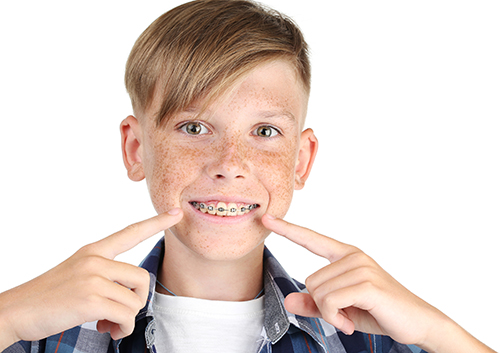
Colorful elastic ligatures (the official name for those tiny bands around your brackets) are often replaced when you come in to have your braces adjusted. Which is great! Now you have the opportunity to go with your team colors, or your school colors, or tones that work with your skin and eyes, or shades that represent your favorite holiday season. Today’s bands come in a wide variety of colors, so you never need to worry about becoming bored with your choices.

But are there certain hues that can be a bit more challenging to work with. Let’s look at some of those trickier tones.

  • Lunch Look-Alikes

If you don’t want kind friends constantly informing you that you have something stuck in your teeth, you might want to leave certain colors off your list. Dark greens and browns can sometimes give the appearance of food trapped in your braces. Have a look at the shades available, and see what is least likely to send you running for a mirror and a toothbrush.

  • Smile Dimmers

A blazing white band might seem like a good match to your blazing white teeth, but for many people, really light colors can make teeth look more yellow. And often bands in shades of yellow can bring out any yellow in your enamel. If you’re looking for a brighter smile, try some darker, richer tones for a gleaming contrast.

  • You’re So Over the Rainbow

If you are someone who loves a monochromatic look, perhaps any colors will be, well, just too colorful. In that case, there are ligatures for you! Silver or grey braces will blend with your metal brackets, and clear or tooth-colored bands will be less obvious with metal or ceramic brackets. Light colored bands can be more prone to staining, so keep that in mind if you’re going for invisibility or a close bracket match.

Now with all that being said, you be you! If you like a color, give it a go. It might be the perfect accessory for your smile and your personality. And, if it doesn’t work . . . no big deal! You can explore another part of the color palette on your very next adjustment to our Frankfort, IL office.

The Importance of Orthodontic Treatment at a Young Age

February 19th, 2020

When you think of orthodontic treatment, you may automatically assume that it only relates to older children and teens with alignment and spacing issues. But this isn’t the case: Orthodontic treatment at Burke Orthodontics offers many benefits when applied at a young age.

By considering orthodontic treatment at a younger age, John Burke and our staff are able to identify your child’s alignment issues early on, and are able to intervene in order to provide treatment as the teeth begin to develop. It is important to start dental care early, not only for proper dental health and the cosmetic benefits, but to improve a child’s overall health as well.

The Benefits of Straighter Teeth

Besides the cosmetic benefits, there are multiple advantages to starting orthodontic treatment at a young age:

  • It can reduce the extent of orthodontic treatment needed later.
  • With early treatment, the pediatric dentist helps guide the teeth into their right position to prevent the removal of teeth and improve an overbite, underbite, or crossbite.
  • Straighter teeth are easier to clean and better for preventing tooth decay.
  • As a benefit to you, the parent, your child’s orthodontic expenses will be much lower with early treatment.
  • Lastly, much early treatment is covered by dental insurance.

Stages of Orthodontic Treatment

Multiple stages are included in early orthodontic treatment, with three stages in all:

The first stage is early treatment that starts around age two or three, and continues until the child is around six years old. This stage deals with preventive measures, such as avoiding bad habits that lead to crooked teeth and creating a plan for the future based on how the teeth are growing in.

During stage two, when the child is six to 12 years old, the first permanent teeth erupt and the dentist looks at possible early treatment for misalignment or bite issues.

Finally, stage three occurs during adolescence to correct any further problems with permanent teeth.

John Burke and our staff are able to see how the teeth first erupt and know right away whether or not your child will need to have braces later on. Early treatment means fewer procedures, cleaner teeth, and less expense.

Contact Us!
call email